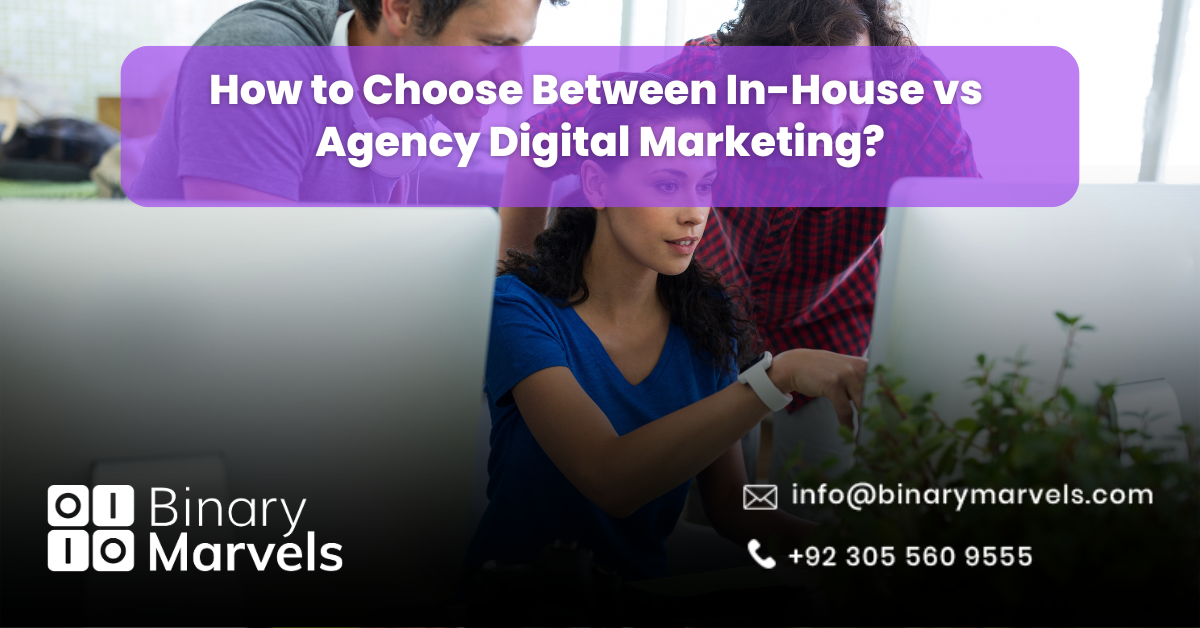
Should your business build an in-house digital marketing team or partner with an external agency to drive growth and visibility online? This is a question many startups, small businesses, and growing companies face when their marketing efforts start to scale and results begin to matter more than experimentation.
Choosing between in-house vs agency digital marketing is not just a staffing decision. It directly affects your budget, campaign performance, speed of execution, and long-term growth strategy. Each approach offers its own advantages and limitations, depending on your business goals, internal resources, and the level of expertise required to compete in today’s digital landscape.
In this guide, we will break down the key differences between in-house and agency digital marketing, helping you understand which option aligns best with your business needs and how to make a confident, informed decision.
What Is In-House Digital Marketing?
In-house digital marketing refers to building and managing a marketing team within your own organization. This team works exclusively on your brand, handling strategy, execution, and optimization across various digital channels such as SEO, paid advertising, social media, content marketing, and email campaigns.
One of the biggest advantages of an in-house team is full control over brand messaging and priorities. Because the team is embedded within your business, they have a deep understanding of your products, services, audience, and internal goals. This often leads to stronger brand consistency and faster internal communication.
However, managing an in-house digital marketing team also comes with challenges. Hiring skilled professionals requires time and budget, ongoing training is necessary to keep up with platform changes, and scaling the team can be costly. For many businesses, these factors play a critical role when deciding whether an in-house approach is the right long-term investment.
What Is an Agency Digital Marketing Model?
An agency digital marketing model involves partnering with an external team of specialists who manage your marketing efforts on your behalf. Instead of hiring individual professionals internally, businesses work with a digital marketing agency that already has experts in SEO, paid ads, content strategy, social media, analytics, and conversion optimization.
One of the key benefits of this model is immediate access to experienced professionals and advanced tools without the overhead costs of full-time hires. Agencies work across multiple industries, which allows them to apply proven strategies, adapt quickly to algorithm updates, and identify opportunities that an internal team may overlook.
On the other hand, working with an agency requires clear communication and well-defined expectations. Since the team is external, businesses must rely on reporting, meetings, and documentation to stay aligned. When managed correctly, this model offers flexibility, scalability, and strong performance, especially for companies looking to grow efficiently.
Also Read: 10 Questions to Ask Before Hiring a Digital Marketing Agency
Cost Comparison: In-House vs Agency Digital Marketing
| Cost Factor | In-House Digital Marketing | Agency Digital Marketing |
|---|---|---|
| Hiring & Recruitment | High upfront costs for hiring skilled professionals | No hiring or recruitment costs |
| Salaries & Benefits | Fixed monthly salaries, benefits, and bonuses | Monthly retainer or project-based fee |
| Training & Skill Upgrades | Ongoing training required to keep skills updated | Included as part of agency expertise |
| Marketing Tools & Software | Separate budget needed for tools and subscriptions | Advanced tools usually included |
| Scalability Costs | Additional hires increase overall costs | Easy to scale up or down without extra overhead |
| Long-Term Financial Risk | Higher commitment and fixed expenses | Lower risk with flexible engagement models |
This comparison highlights how agencies often provide cost efficiency and flexibility, while in-house teams may be more suitable for organizations with long-term, stable marketing needs.
When In-House Digital Marketing Makes Sense?
In-house digital marketing is often the right choice for businesses that require complete control over their marketing operations and brand communication. Companies with complex products, strict compliance requirements, or highly specific audiences may benefit from a dedicated internal team that understands every detail of the business.
This model also works well for organizations with the budget to invest in skilled professionals, training, and long-term team development. Enterprises that run continuous, large-scale campaigns and rely heavily on internal collaboration often see stronger alignment and consistency with an in-house approach.
If your business values direct oversight, long-term brand building, and internal knowledge retention, in-house digital marketing can be a strategic and sustainable solution.
When Hiring an Agency Is the Smarter Choice?
Hiring an agency is often the smarter choice for businesses that need expert support without the complexity of building and managing an internal team. Startups, small businesses, and growing companies frequently choose this model to access specialized skills, advanced tools, and proven strategies at a predictable cost.
An agency can quickly launch and optimize campaigns, making it ideal for businesses focused on fast results, lead generation, or entering competitive markets. This approach is also beneficial when internal resources are limited or when marketing needs fluctuate throughout the year.
For companies looking to stay agile while leveraging professional digital marketing services, partnering with an agency can provide the flexibility and performance needed to support sustainable growth.
Hybrid Model The Best of Both Worlds
The hybrid digital marketing model combines the strengths of both in-house teams and agencies. In this approach, businesses keep core strategy, brand management, and decision-making internally while outsourcing execution or specialized tasks to external experts.
This model allows companies to maintain control over their vision and messaging while benefiting from the technical expertise, tools, and scalability that agencies offer. For example, an in-house team may handle content planning and brand communication, while an agency manages paid advertising, SEO, or performance optimization.
A hybrid setup works especially well for growing businesses that want flexibility without committing fully to either model. It provides cost efficiency, access to advanced skills, and the ability to scale marketing efforts while keeping strategic ownership within the organization.
How to Make the Final Decision?
Making the final decision between in-house and agency digital marketing requires a clear understanding of your business goals, budget, and internal capabilities. Start by evaluating your current marketing challenges and the outcomes you want to achieve, whether that is brand awareness, lead generation, or revenue growth.
Consider the level of expertise you need and how quickly you expect results. If your team lacks specialized skills or you need to scale campaigns rapidly, an agency may be the better option. On the other hand, if long-term brand control and internal alignment are top priorities, investing in an in-house team could make more sense.
Ultimately, the right choice is the one that aligns with your growth strategy, resources, and timeline. Reviewing performance regularly and staying flexible will help ensure your digital marketing efforts continue to deliver measurable results.
Choosing the Right Partner Matters
No matter which model you choose, the success of your digital marketing efforts ultimately depends on working with the right people. Experience, communication, transparency, and a clear understanding of your business goals are far more important than the structure itself.
If you decide to outsource or follow a hybrid approach, selecting a reliable partner with proven processes and technical expertise is critical. A trusted software house can offer not only marketing execution but also strategic alignment with your website, technology stack, and long-term growth plans.
The right partner acts as an extension of your team, focusing on results rather than just tasks. Taking the time to evaluate capabilities, case studies, and communication style will help ensure your digital marketing investment delivers consistent and scalable outcomes.
Supercharge Your Business with Digital Marketing Today!
As a trusted Digital Marketing Agency in Rawalpindi, we deliver result-driven digital marketing services designed to boost your online presence, generate leads, and grow your business.
Don’t wait, connect with us now and take your brand to the next level!
Conclusion
Choosing between in-house and agency digital marketing is not a one-size-fits-all decision. Each approach offers distinct advantages depending on your business size, goals, budget, and growth expectations. In-house teams provide deeper brand control and long-term alignment, while agencies bring flexibility, speed, and access to specialized expertise.
The key is to evaluate where your business stands today and where you want it to go tomorrow. By understanding your resources and priorities, you can select a model that supports sustainable growth and delivers measurable results. A well-informed decision will ensure your digital marketing efforts remain effective, adaptable, and aligned with your overall business strategy.
Frequently Asked Questions
Is in-house digital marketing cheaper than hiring an agency?
In-house marketing can become cost-effective over time for large organizations, but it usually requires higher upfront investment. Agencies often provide better short-term value by including expertise, tools, and execution in one package.
Can small businesses benefit from an in-house marketing team?
Small businesses can benefit, but only if they have the budget and workload to justify full-time roles. Many small businesses start with an agency or hybrid model to stay flexible.
How long does it take to see results with an agency?
Results depend on goals and channels, but agencies typically deliver faster traction due to experience, tested strategies, and ready-to-use tools.
Is a hybrid model suitable for long-term growth?
Yes, a hybrid model is often ideal for long-term growth. It allows businesses to keep strategic control internally while leveraging external expertise for execution and scaling.
Can I switch between models later?
Absolutely. Many businesses start with an agency, transition to in-house as they grow, or adopt a hybrid approach based on changing needs and resources.