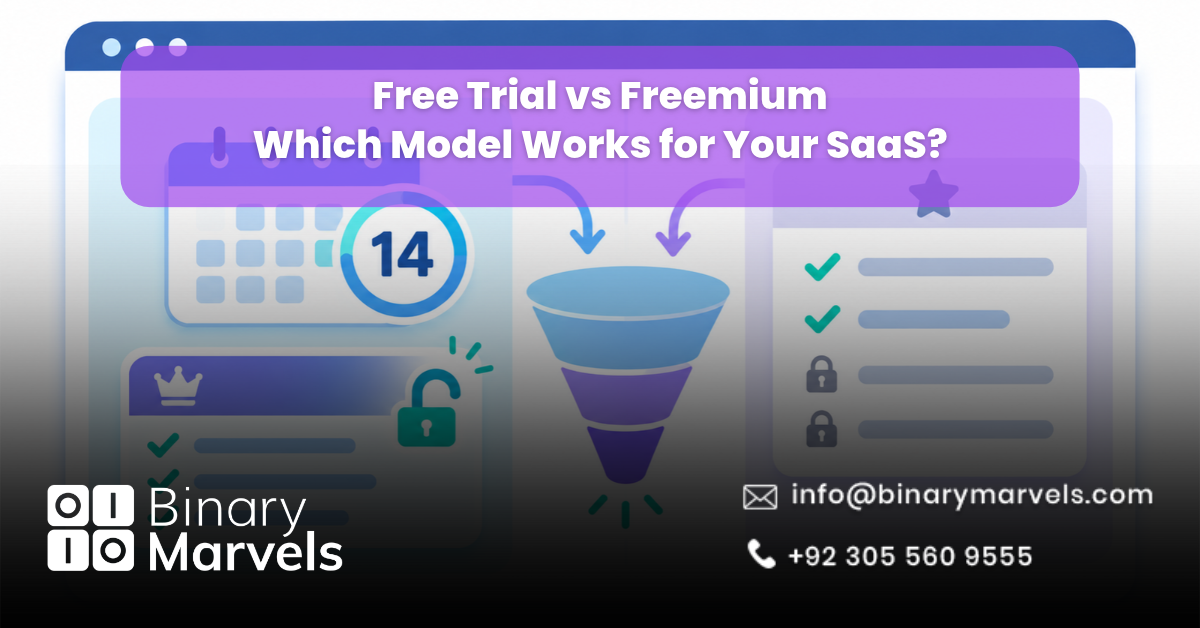
Choosing between a free trial vs freemium model is one of the first big pricing calls a SaaS founder makes. It decides how many people sign up, how many pay, and what you spend on those who never do. Unlike traditional software, where buyers pay once for a license, SaaS runs on recurring revenue. So your free offer has one job: turn users into paying subscribers.
This guide compares both models using 2026 data and gives you a simple framework to pick one.
What Is the Difference Between a Free Trial and Freemium?
The core difference is time versus features. A free trial gives full access for a set period, while freemium gives limited access with no end date.
What Is a Free Trial?
A free trial lets users test your paid product for a fixed window, usually 7, 14, or 30 days. Then they pay or lose access. There are two types:
- Opt-in trial: No credit card is needed to start.
- Opt-out trial: A card is required upfront, and billing starts automatically when the trial ends.
What Is a Freemium Model?
A freemium model offers a free plan forever, but with limits on features, usage, or seats. Users upgrade when they outgrow those limits. Slack is a classic example. Its free plan only shows the last 90 days of message history and allows up to 10 apps.
| Factor | Free Trial | Freemium |
|---|---|---|
| Access | Full product | Limited product |
| Time limit | Yes (often 14 days) | No |
| Signup volume | Lower | Higher |
| Conversion rate | Higher | Lower |
| Cost of free users | Short term | Ongoing |
| Best fit | Complex or higher-priced tools | Simple, viral, low-cost tools |
Free Trial vs Freemium Conversion Rates in 2026
Most articles quote one blended conversion rate, which hides the real story. The 2026 Conversion Report from ChartMogul, Growth Unhinged, and ProductLed splits free-to-paid conversion rates by model:
| Model | Good (median) | Great (top 25%) |
|---|---|---|
| Freemium (standard signup) | 3 to 5% | 8 to 12% |
| Free trial (no card) | 4 to 6% | 10 to 15% |
| Free trial (card required) | 25 to 35% | 50 to 60% |
| Reverse trial | 4 to 6% | 8 to 12% |
Trials look like the winner, but conversion rate is only half the funnel. The same report tracks paying customers per 1,000 website visitors:
- Freemium: 9% sign up and 5.5% convert, giving about 5 paying customers.
- Opt-in free trial: 4.5% sign up and 8% convert, giving about 3.6 paying customers.
- Card-required trial: 3.5% sign up and 30% convert, giving about 10.5 paying customers.
Freemium makes up for its lower conversion rate with more signups. A card-required trial brings the most paying customers, but filters out curious users who might upgrade later. Even so, 61% of SaaS products use a free trial as their main entry point.
When Does a Freemium Model Work Best?
Choose freemium when:
- Cost to serve is low. Each free account costs very little in hosting and support.
- Users see value fast. No heavy setup or data import is needed.
- The product spreads itself. Sharing, invites, and team use pull in new users.
- Your market is huge. A small upgrade rate across many users still adds up.
- Upgrade triggers are clear. Users hit a limit they care about, such as storage, history, or seats.
Free users who upgrade and then add seats also lift your net revenue retention over time.
When Does a Free Trial Work Best?
A free trial model fits products that need time to prove their worth. Choose it when:
- Setup takes effort. Users need days to import data or build workflows.
- Your price is higher. Bigger contract values justify sales follow-up during the trial.
- Your market is narrow. A vertical SaaS product for clinics or law firms cannot count on millions of free users.
- The full product sells itself. Using every feature creates a fear of losing it when the clock runs out.
Most B2B SaaS tools lean toward trials for these reasons. A trial gives your sales and customer success teams a clear window to guide users to their first real result.
The Hidden Cost of Free Users
Every free user costs money. With a trial, that cost ends in weeks. With freemium, it can last forever:
- Infrastructure: Hosting and storage grow with every account. Even a managed platform like Azure App Service bills on the resources you use, and free users use them too.
- AI usage: If your product calls an AI model on every action, each free user has a direct cost per use. Third-party AI API usage alone can add $500 to $5,000 a month to your SaaS development cost.
For AI-heavy products, cap free usage with credits.
The Reverse Trial: A Hybrid of Both Models
A reverse trial starts every new user on the full paid plan for a set period, then moves them to a free plan instead of locking them out. Airtable gives new users 14 days of its Pro plan before moving them to Free. Calendly gives new accounts 14 days of premium features, then downgrades them.
Why it works:
- Users see the best version of your product first.
- Losing premium features feels worse than never having them.
- Non-paying users stay, so they can upgrade later.
Only 7% of products use it as their main entry point, and ChartMogul found no clear win over other models, so test it before committing.
How to Choose the Right SaaS Pricing Model: A 5-Question Framework
- How fast do users see value? Minutes point to freemium. Days or weeks point to a free trial.
- What does each free user cost? Near zero makes freemium safe. High costs call for a trial or tight limits.
- How big is your market? Millions of potential users suit freemium. Thousands suit a trial.
- What is your price point? Low self-serve plans suit freemium. Higher prices suit a trial.
- Does the product spread through use? If yes, try freemium or a reverse trial. If no, choose a trial.
If answers split, a reverse trial is often the safest test. Make this choice early, while you plan how to develop a SaaS product, because it shapes your architecture.
How to Build Your Free Model Into the Product
Your pricing model is also a technical decision. Good SaaS development treats plan logic as a core feature, because switching models later is hard. Plan for:
- Entitlements and feature flags to turn features on or off by plan.
- Usage metering to track limits like seats, storage, or AI credits.
- Billing logic for trial expiry, auto-downgrades, upgrades, and failed payments.
- Abuse protection against endless free or trial accounts.
Fake signups are a real SaaS security concern. Rate limits, email checks, and device checks help you secure your SaaS application and protect your margins.
Your SaaS tech stack should support this from day one. Ready-made billing tools handle simple plans, while custom SaaS gives you full control over complex rules. Our SaaS Development Services cover plan logic, metering, and billing. If you are comparing vendors, see how to choose the right SaaS development company, or browse our list of the top SaaS app development company options in the USA.
Frequently Asked Questions
Is a free trial or freemium better for B2B SaaS?
Most B2B SaaS products do better with a free trial, because they need setup, team buy-in, and proof of return on investment. Freemium works for B2B only when the product is simple, spreads across teams, and costs little to serve.
What is a good free-to-paid conversion rate for SaaS?
It depends on the model. A good rate is 3 to 5% for freemium, 4 to 6% for an opt-in free trial, and 25 to 35% for a card-required trial. Always compare against your own model, not a blended average.
How long should a SaaS free trial be?
14 days is the most common length, used by 62% of trial products. The right length is the time a typical user needs to reach a first real result, so simple tools can use 7 days and complex platforms 30.
Can you switch from freemium to a free trial later?
Yes. Many companies keep existing free users on the old plan and apply the new model only to new signups. Building entitlements and billing logic early makes this much easier.
Final Thoughts
Freemium wins on reach and fits simple, low-cost, viral products with huge markets, while a free trial wins on conversion and fits complex, higher-priced tools that need time to prove value. The 2026 data shows freemium’s extra signups can offset its lower conversion rate, and card-required trials bring in the most paying customers per visitor. If your answers split, test a reverse trial, and build your plan logic into the product early so you can change models without a rebuild.