
Choosing between a SaaS agency and a freelancer is one of the first real decisions a founder makes, and it shapes everything that follows: your budget, your timeline, and how well your product holds up once real users show up. Get it right and you build a platform that scales cleanly. Get it wrong and you spend the next year fixing what should have been built correctly the first time.
This guide breaks down what a SaaS development agency and a freelance developer actually offer, what each one costs once you count the hidden expenses, and how to match your choice to the stage your business is in right now.
What Does “SaaS Agency vs Freelancer” Actually Mean?
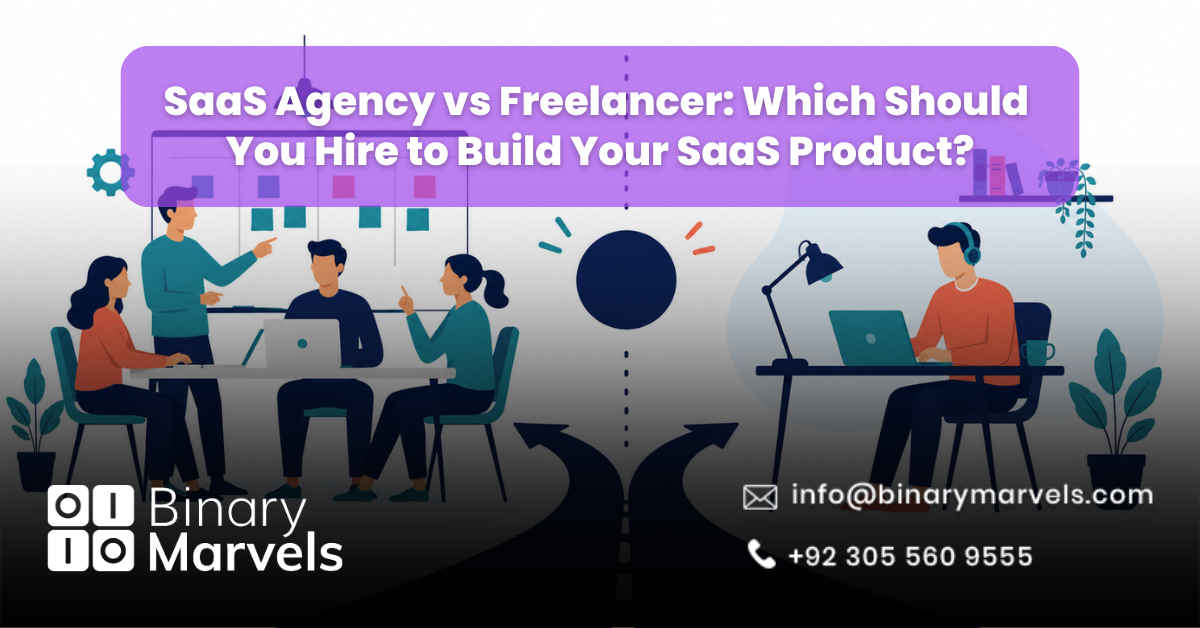
A SaaS agency is a team of specialists, developers, designers, project managers, and QA engineers, who work together under one roof to plan, build, and support your product. A freelancer is a single independent developer who takes on your project directly, usually without a supporting team behind them.
Agencies offer structure, cross-functional skill, and continuity at a higher monthly cost. Freelancers offer speed, lower rates, and direct communication, but the entire project depends on one person’s availability and skill set. The right choice depends on your product’s complexity, your compliance needs, and how much project management you can realistically handle yourself.
What a SaaS Development Agency Brings to the Table
Working with a full SaaS development team changes what is actually possible on your build. An agency typically brings:
- Cross-functional expertise. Frontend, backend, cloud infrastructure, security, and QA specialists working on your product at the same time, using a modern, well-supported stack rather than whatever one developer happens to know. Reviewing the top SaaS development technologies agencies typically work with shows the range one team can cover.
- Built-in project management. An account or project manager tracks timelines, coordinates the team, and keeps you updated, so you are not chasing status updates yourself.
- Structured, repeatable process. Discovery, architecture planning, development sprints, testing, and deployment follow a proven sequence instead of an improvised workflow.
- Continuity. If one developer leaves or gets sick, the project keeps moving. Your product is not tied to a single person’s calendar.
- Higher cost and more onboarding. Agency retainers cost more than a freelancer’s hourly rate, and onboarding a full team takes longer than briefing one developer.
At Binary Marvels, this is what a decade of building SaaS development services for clients across 15 or more countries looks like in practice: a team that plans architecture before writing code, and stays available around the clock once the product is live.
What Hiring a Freelance SaaS Developer Looks Like
A freelancer can be the right call, especially early on. The trade-offs look different from an agency’s:
- Lower cost per hour. Freelance rates are usually well below agency retainers, which matters when budget is tight.
- Direct communication. You talk straight to the person writing the code, with no account manager in between.
- Fast turnaround on small, well-defined tasks. A freelancer can move quickly on a scoped feature or a simple MVP screen.
- Single point of failure. If your freelancer gets sick, takes another client, or simply disappears, your project stalls. There is no backup.
- Limited skill range. One person rarely covers frontend, backend, cloud architecture, and security equally well, so complex builds often need multiple freelancers stitched together, which adds its own coordination burden.
Freelancers work best for narrow, bounded problems. A SaaS product with evolving scope, multiple integrations, and real compliance requirements tends to outgrow what one person can safely manage.
The Real Cost Comparison: Hourly Rate vs. Total Cost of Ownership
Comparing an agency and a freelancer purely on hourly rate is misleading. A freelancer’s lower rate often hides costs that show up later:
- Coordination overhead. Without a project manager, you become the project manager, reviewing code, chasing timelines, and managing scope yourself.
- Rework and technical debt. A single developer working alone, without code review or a second set of eyes, is more likely to ship shortcuts that need fixing later.
- Delivery risk. If a freelancer misses a deadline or leaves mid-project, you pay to onboard someone new who has to learn the codebase from scratch.
- Opportunity cost. Every week spent managing a stalled freelance project is a week your product is not in front of customers.
For a full picture, it helps to review how much SaaS development costs broken down by phase, discovery, design, development, testing, and post-launch support, so you can compare true totals instead of just the sticker price.
How AI Coding Tools Are Changing the Freelancer Equation
AI coding assistants have made solo developers faster than ever. Today, most professional developers use AI tools daily to speed up routine coding tasks. That speed comes with a catch that matters directly to SaaS founders.
Veracode’s 2025 GenAI Code Security Report tested more than 100 AI models on security-focused coding tasks and found that 45 percent of AI-generated code introduced known OWASP Top 10 vulnerabilities, including issues like broken access control and weak session handling. The pass rate barely improved across newer model generations. For a SaaS product built on shared, multi-tenant infrastructure, a single overlooked flaw in one part of the codebase can expose data across every customer account, not just one.
An agency’s built-in code review, QA testing, and security process catches these issues before launch. A solo freelancer generating code quickly with AI assistance, without a second developer reviewing it, is more likely to ship exactly the kind of flaw this report describes. If security and compliance matter to your product, understanding how to secure SaaS applications before you pick a build partner is worth the time.
A Stage-Based Framework: Which One Fits Your Business Right Now
The right choice depends heavily on where your product currently stands.
| Your Stage | Better Fit | Why |
|---|---|---|
| Early idea, testing a concept with a simple prototype | Freelancer | Low cost, fast iteration, low complexity |
| Building your first real MVP with paying users in mind | Agency (or agency-freelancer hybrid) | Needs architecture planning and QA from day one |
| Scaling with growing users, multiple integrations | Agency | Requires structured process, security, and team continuity |
| Enterprise SaaS with compliance requirements | Agency | Needs dedicated security, compliance mapping, and long-term support |
If you already have a technical co-founder who can manage code review, architecture decisions, and quality control in-house, a freelancer can safely handle narrow, well-defined tasks under that supervision. Without that technical oversight, an agency is the lower-risk choice, because you are paying for project management as much as for code.
Understanding how SaaS differs from traditional software also helps here. SaaS products update continuously, serve many customers on shared infrastructure, and need to scale horizontally, requirements that a narrowly scoped freelance engagement is not always built to handle long term.
Questions to Ask Before You Decide
Before signing with either option, get clear answers to:
- Can they show a live SaaS product they built, not just mockups or a portfolio site?
- Who reviews the code before it ships, and is there a documented QA process?
- What happens to the project if the developer becomes unavailable?
- How do they handle security, tenant isolation, and compliance requirements?
- What does support look like after launch, and is it included or billed separately?
If you want to compare vetted options directly, reviewing a proven SaaS app development company shortlist, or working through how to choose the right SaaS development company, gives you a structured way to evaluate anyone on your list. Once you have a partner in mind, the step-by-step process for how to develop a SaaS product shows what the build should actually look like from planning to launch.
Frequently Asked Questions
Is a freelancer cheaper than a SaaS development agency?
A freelancer’s hourly rate is usually lower, but the total cost often evens out once you factor in coordination time, rework, and delivery risk. For simple, well-defined projects, a freelancer can still be the more affordable option overall.
Can a freelancer build a full SaaS product alone?
A single freelancer can build a simple MVP, but most SaaS products need frontend, backend, cloud infrastructure, and security expertise together, which usually means multiple freelancers or a team rather than one person.
When should a startup switch from a freelancer to an agency?
The switch usually makes sense once the product has paying customers, needs to scale past a few hundred users, or has to meet a compliance standard like SOC 2, GDPR, or HIPAA.
Are AI coding tools making freelancers a safer choice?
Not automatically. AI tools speed up development, but independent research shows a large share of AI-generated code still contains security flaws, so the value of a second reviewer or a full QA process has not gone away.
Does Binary Marvels work with early-stage startups or only established companies?
Binary Marvels supports SaaS founders at every stage, from early MVP builds to scaling platforms with compliance needs, with a team that has delivered SaaS projects across 15 or more countries over 10-plus years.
Conclusion
A SaaS agency offers structure, cross-functional skill, and continuity at a higher cost, while a freelancer offers speed and lower rates but carries more delivery risk and a narrower skill range. The right choice depends on your product’s stage, its complexity, and whether you have the technical oversight in-house to manage a solo developer safely. For early prototypes a freelancer often works fine, but once real users, real data, and real compliance requirements enter the picture, an experienced agency becomes the lower-risk investment.
If you are ready to talk through your SaaS build with a team that has done this for clients across 15-plus countries over the past decade, reach out to Binary Marvels at info@binarymarvels.com.