Inquiries arrive at midnight, documents go missing, and half the applicants stop replying after the first email. Admissions follow-up automation solves this by sending the right message at the right time, without waiting for a staff member to remember. This guide shows how schools and colleges can set it up step by step, which channels work best, and how to keep every message personal.
Why Admissions Follow-Up Breaks Down
Most follow-up problems come from three gaps:
- Slow first replies: Industry reports often put admissions response times between 24 and 72 hours, while students send inquiries to several schools at once.
- Limited office hours: An office open 40 hours a week is closed for about three quarters of the week. Late-night and weekend inquiries simply wait.
- Manual tracking: Notes sit in spreadsheets, inboxes, and memory. Applicants with missing documents or half-finished forms slip through.
Speed matters here. A widely cited lead response study from the sales world found that teams replying within five minutes connected with far more leads than teams waiting thirty. That research is not about schools, but the pattern fits admissions well: the school that answers first usually starts the conversation. At four-year colleges, the admit-to-enroll rate (yield) often sits between 20 and 40 percent, so every lost applicant hurts.
What Admissions Follow-Up Automation Covers
Automation does not replace counselors. It handles repeat tasks so your team can focus on real conversations. The most useful automated actions are:
- An instant reply to every new inquiry
- A follow-up email after a brochure or prospectus download
- Reminders for missing documents such as transcripts, ID copies, or fee proof
- Nudges for applicants who abandoned the form midway
- Deadline, interview, and campus visit reminders
- Offer, deposit, and enrollment confirmation reminders
- Staff alerts when a student replies, clicks, or books a call
This is one practical use of business process automation, where software handles rule-based steps and people handle judgment.
How to Automate Admissions Follow-Up Step by Step
Step 1: Map Your Admissions Funnel
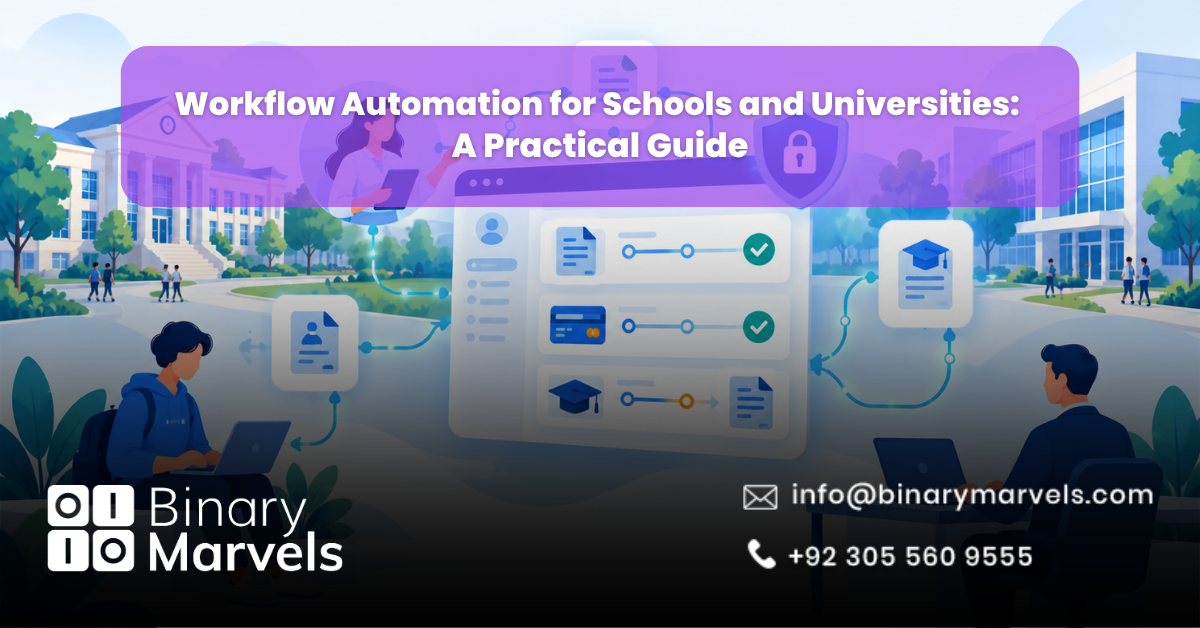
List every stage: inquiry, application started, documents submitted, interview, offer, deposit, and enrollment. For each stage, write down who follows up, through which channel, and how soon. Then find the points where students go quiet. For most schools these are right after the inquiry, during document collection, and between the offer and the deposit.
Start with those gaps. If your staff spend hours each week chasing documents by hand, you are already seeing the signs your business needs automation.
Step 2: Centralize Student Data in an Admissions CRM
Create one record for every prospective student. Connect your website forms, ad lead forms, WhatsApp inquiries, call logs, and application portal to a single admissions CRM. Without one source of truth, automation sends wrong messages, like reminding a student about a document they already uploaded.
Pick your tools with care. This list of workflow automation software options is a good place to compare features before you commit.
Step 3: Build Trigger-Based Follow-Up Sequences
Every sequence needs four parts: a trigger, a message, a wait time, and an exit rule. The exit rule is the most missed part. When a student uploads the missing document, the reminders must stop at once. Nothing frustrates an applicant more than a reminder for something already done.
Step 4: Choose the Right Channels
Different messages suit different channels:
- Email: Program details, fee structures, and attachments.
- SMS: Short nudges and deadline alerts.
- WhatsApp: Quick two-way chats. It is widely used by students and parents in Pakistan, the Gulf region, India, and South Asian communities in the UK.
- Phone calls: High-value moments such as offer discussions and scholarship questions.
Get consent first. In the US, texting prospects requires prior consent under the TCPA. In the UK and EU, GDPR and PECR rules apply. On WhatsApp, business-started chats outside the 24-hour reply window need pre-approved message templates. Always add a clear opt-out.
Step 5: Add an AI Chatbot for After-Hours Questions
A chatbot can answer questions about fees, deadlines, and eligibility at 2 a.m., collect the student’s name, program choice, and contact details, and book a call with a counselor. It closes the 24/7 coverage gap without hiring night staff.
Modern AI business automation goes further than fixed rules by understanding free-text questions. If you are unsure whether you need rules, bots, or AI, see how BPA, RPA, and AI automation differ.
Step 6: Set Clear Human Handoff Rules
Automation should create more human contact, not less. Decide in advance when a counselor steps in:
- The student asks about scholarships, fees, or visas
- The student replies with doubt or a complaint
- A parent calls or messages
- The student opens the fee page or offer email several times
Assign the lead to a counselor within minutes, set a response time target, and escalate to a manager if nobody acts within a few hours.
A Sample Admissions Follow-Up Timeline
Use this as a starting point and adjust it after testing:
- Minute 0: Instant email and WhatsApp or SMS confirming receipt, with a link to book a call.
- Hour 1: A task is created for a counselor to call the student.
- Day 1: Email with program details and fee structure.
- Day 3: Short text with the booking link if there is no reply.
- Day 7: Email answering the top three questions for that program.
- Day 14: Final check-in offering a call.
For incomplete applications, remind the student after 24 hours, again after three days, and then ask a counselor to call. For missing documents, remind at day two, day five, and day seven. For offers, send deposit reminders at three days, seven days, and two days before the deadline.
Online schools can use the same approach, as shown in this guide to automation for online course providers.
No-Code Tools or a Custom Build?
No-code platforms suit small schools with simple flows. Custom builds make sense when you have several campuses, an old student information system, or special admission rules. This comparison of no-code automation vs custom-built automation explains the trade-offs.
Budget and team size matter too. Read how much business automation costs before you set a budget, and weigh in-house vs outsourced automation based on your IT capacity.
If you decide to outsource, a good business automation company will start with your funnel, not with a tool. Use these questions to ask before you hire a vendor.
Common Mistakes to Avoid
- Automating a broken process: Fix unclear steps first, then automate.
- Sending too many messages: Two or three touches a week is plenty.
- Using generic copy: Add the student’s name, program, and intake date.
- Skipping exit rules: Stop messages the moment the student acts.
- Removing humans completely: Keep counselors for complex questions.
- Ignoring consent: Track opt-ins and honor opt-outs.
Metrics That Show Your Follow-Up Is Working
Review these every month:
- Average time to first response
- Contact rate (inquiries that reach a real conversation)
- Inquiry-to-application rate, which is commonly benchmarked between 15 and 25 percent
- Average days to complete documents
- Application-to-enrollment rate
- Cost per enrolled student
If response time drops but enrollment stays flat, check message quality and handoff speed.
Why Choose Binary Marvels for Admissions Automation
Binary Marvels has over 10 years of experience, five industry awards, clients in more than 15 countries, and 24/7 support. The team builds custom chatbots, AI voice agents, appointment setters, and learning platforms for education clients. If you want help connecting your forms, CRM, and messaging channels, explore our business automation services for schools and colleges.
Frequently Asked Questions
What is admissions follow-up automation?
It is the use of software to send timely emails, texts, and reminders to prospective students based on their actions, such as submitting an inquiry or leaving a form unfinished. Staff are alerted only when a personal conversation is needed.
How fast should schools reply to a new inquiry?
Send an automatic acknowledgement within a minute or two, and aim for a human follow-up within the hour during office time. Reports often show typical admissions replies taking one to three days, so even same-day contact is a clear advantage.
Will automation make admissions feel impersonal?
Not if you use the student’s name, program, and stage in each message, and hand over to a counselor when questions get complex. Automation takes care of routine reminders, so counselors have more time for real conversations.
What do I need to start?
You need a CRM that holds all student records, a list of your funnel stages, a few simple message sequences, and consent from students to contact them. Start with the inquiry reply and document reminders, then add more later.
Conclusion
Admissions follow-up automation helps schools and colleges reply faster, remind students on time, and stop applicants from slipping away. The best results come from a mapped funnel, one central CRM, trigger-based sequences with exit rules, and clear handoffs to counselors. Start small with instant replies and document reminders, measure response time and enrollment, and grow from there.