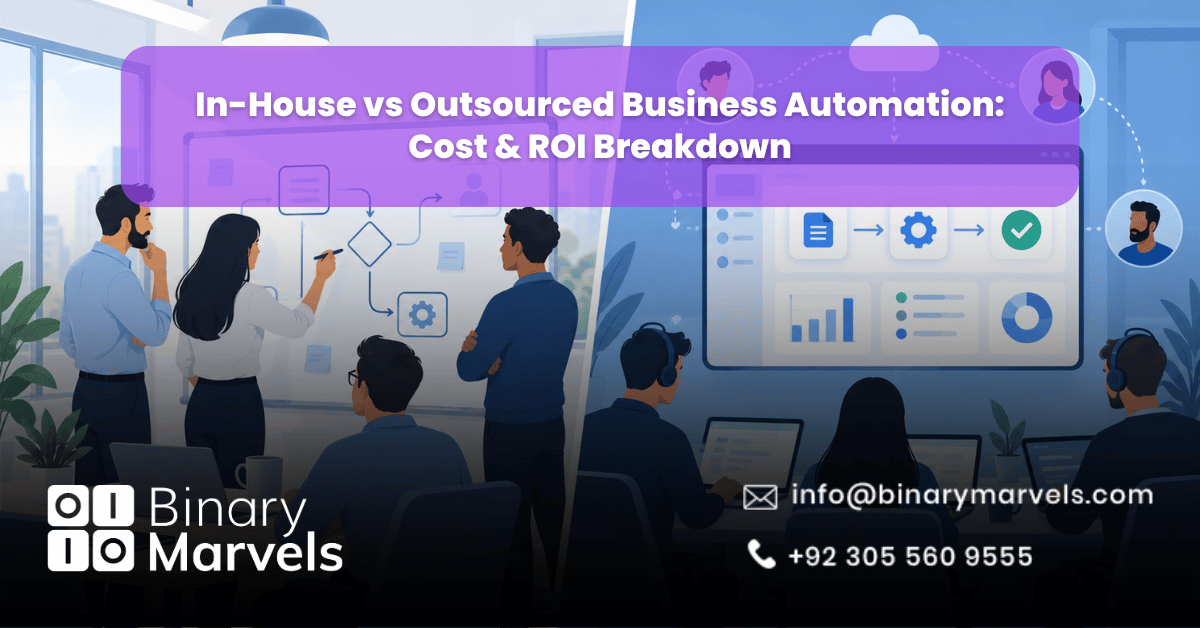
Every growing business hits the same fork in the road. Manual work is eating up hours, mistakes are creeping into routine tasks, and someone in leadership finally asks the right question: should we build automation in-house, or bring in a partner to do it for us?
The answer depends on your budget, your team, and how fast you need results. This breakdown looks at the real costs, not just the sticker price, so you can compare in-house and outsourced business automation using actual numbers instead of guesswork.
Outsourced automation costs less upfront and shows results in 2 to 4 weeks, since a specialist team is already built and trained. In-house automation costs more, usually taking 3 to 6 months before it delivers, but gives you full control over the process and the data. Most small and mid-sized businesses get faster ROI from outsourcing, while larger companies with complex, sensitive workflows often find in-house worth the extra cost.
Why This Decision Matters for Growing Businesses
Automation is not a nice-to-have anymore. If your team is still copying data between spreadsheets, chasing approvals over email, or manually scheduling recurring tasks, you are already paying a hidden cost in lost hours. Recognizing signs your business needs automation services is the first step, and the second is figuring out who should build it.
Get this decision wrong and you either overspend on a system your team cannot maintain, or you underinvest and end up rebuilding everything a year later. That is why cost and ROI need to be compared side by side, not looked at in isolation.
In-House Business Automation: Real Costs
Building automation with your own team feels like the safer choice on paper. You keep full control, and nothing leaves your building. But the real cost adds up fast once you look past the subscription price.
Setup and Staffing Costs
To build automation internally, you need at least one automation engineer or developer, plus time from your operations and IT staff to map out workflows. Salaries for a skilled automation or RPA developer can run well into six figures a year, before benefits, training, and tooling.
You are also paying for infrastructure, platform licenses, and ongoing cloud costs. None of this shows up in a single invoice, which is why in-house budgets tend to run over.
Time to Value
Hiring alone can take one to three months. After that, your new hire needs time to learn your existing processes before they can start building. Most businesses report three to six months before an in-house automation project delivers its first real result.
In-house automation, at a glance:
- Higher fixed payroll and recruitment cost
- Full ownership of your workflows and data
- Slower to scale because you are limited by hiring
- Best suited for highly sensitive or deeply custom processes
Outsourced Business Automation: Real Costs
Outsourcing shifts the cost structure from fixed salaries to variable project or retainer fees. Instead of hiring and training, you pay a specialist team that already has the tools and experience in place.
Pricing Models
Outsourced automation projects are usually priced one of two ways: a fixed fee for a defined scope, or a monthly retainer for ongoing support as your needs grow. Pricing depends heavily on complexity, so it is worth reviewing how much business automation costs before setting a budget, since a simple workflow and a multi-system integration land in very different price ranges.
Deployment Speed
Because an outsourced partner has already built similar systems before, deployment is faster. Many straightforward projects go live in two to four weeks rather than months, so you start seeing time savings much sooner.
Outsourced automation, at a glance:
- Lower upfront cost, spread out as ongoing fees
- Faster time to launch since the team is already trained
- Some dependency on the vendor for changes and support
- Best suited for standard, high-volume, or fast-turnaround needs
Cost & ROI Comparison at a Glance
| Factor | In-House Automation | Outsourced Automation |
|---|---|---|
| Initial cost | High (salary, hiring, tooling) | Low to moderate (project or retainer fee) |
| Time to value | 3 to 6 months | 2 to 4 weeks |
| Cost structure | Fixed, ongoing payroll | Variable, tied to scope |
| Control over process | Full internal control | Shared, depends on vendor terms |
| Maintenance | Handled by your own team | Usually included in retainer |
| Best fit | Large, complex, ongoing needs | SMBs, focused projects, fast rollout |
How to Calculate ROI for Each Model
A simple way to compare ROI is to work out the time and cost you save each month, then divide it by what you spent to get there.
ROI = (Monthly savings from automation − Monthly cost of automation) ÷ Total setup cost
Say a manual process currently costs your team $4,000 a month in labor hours. An outsourced project costs $8,000 to build and $500 a month to maintain. Within two months, the savings already cover the retainer, and by month three you have recovered most of the setup cost. An in-house build with a $200,000 annual staffing cost needs a much larger, steadier stream of savings to break even, which is why smaller businesses usually see faster ROI from outsourcing.
Hidden Costs Most Comparisons Miss
Most articles stop at salary versus retainer fee, but the details below actually decide your total cost.
- Choosing the wrong automation type. Picking the wrong approach wastes money either way. Understanding the difference between BPA, RPA, and AI automation before you build helps you avoid paying for capability you do not need.
- Build approach. Whether you go with no-code tools or a custom-built automation changes both your upfront cost and what you spend later on fixes and scaling.
- Knowledge transfer risk. If only one person understands how a system works, you are exposed the moment they leave.
- Scope creep. Outsourced projects without a clear scope tend to grow in cost through “small” add-ons.
- Compliance overhead. Regulated industries face extra review costs that general automation quotes often leave out.
Which Model Fits Your Business?
There is no single right answer, but a few factors usually point you in the right direction:
- Company size and budget. Smaller teams with tighter budgets generally get more value from outsourcing, since it avoids the fixed cost of new hires.
- Process sensitivity. Highly proprietary workflows may justify the higher cost of in-house control.
- Industry regulation. Sectors with strict compliance needs, such as business automation for healthcare practices, often benefit from a partner who already understands the regulatory landscape.
- Speed requirements. If you need results this quarter, outsourcing is almost always the faster path.
The Hybrid Approach
Many businesses do not need to pick one side completely. A hybrid model keeps sensitive, core processes in-house while outsourcing routine or high-volume tasks to a specialist. This is common in professional services automation for small business, where teams want to protect client data but still need help scaling repetitive admin work.
The hybrid model gives you a middle ground: internal ownership where it matters most, and the speed and savings of external business automation services everywhere else.
Why Choose Binary Marvels for Business Automation
With over 10 years in the industry and clients across 15 or more countries, Binary Marvels builds automation that fits your actual budget and timeline, not a one-size-fits-all package. Our team designs custom workflows, chatbots, and AI-driven systems instead of reselling generic no-code templates, backed by round-the-clock support once your automation goes live. If you are still weighing your options, our guide on how to choose a business automation company walks through what to look for before you sign a contract.
FAQs
Is outsourced automation cheaper than in-house automation?
In most cases, yes, at least short term. Outsourcing avoids the fixed cost of salaries and benefits, so you pay only for the project or a monthly retainer. In-house automation can become cheaper over a longer period if your needs are large and constant enough to justify a full-time team.
How long does it take to see ROI from business automation?
Outsourced projects often show measurable savings within two to three months because deployment is faster. In-house builds usually take three to six months just to launch, so ROI shows up later, often within the first year once the system is fully running.
Can a small business afford outsourced automation?
Yes. It is often more accessible for small businesses because it avoids hiring a full-time developer. Many providers offer project-based pricing that scales with the task, so you only pay for what you need right now.
What is the biggest risk of building automation in-house?
Underestimating the ongoing cost of maintenance and staff turnover. If the person who built your automation leaves, your team can be left without anyone who understands how it works, which often leads to a costly rebuild.
Conclusion
In-house automation gives you full control and long-term ownership, but it comes with higher upfront costs and a slower path to results. Outsourced automation trades some of that control for speed, lower initial spend, and faster ROI, making it the better fit for most small and mid-sized businesses. The right choice ultimately depends on your budget, your timeline, and how sensitive your processes are, with a hybrid approach often giving businesses the best of both.